Write a houseguest note that survives an absent host
A note for a guest should answer a few immediate questions without requiring you to be present. Practise grouping useful information, distinguishing a request from permission and writing a clear contact instruction. Keep access information fictional during language practice.
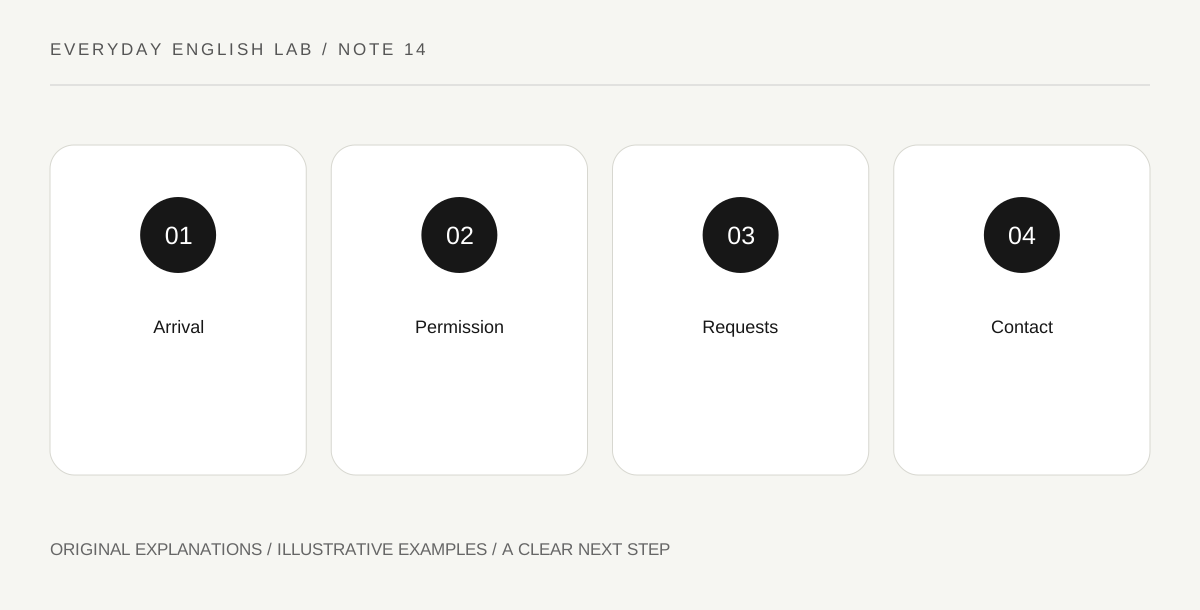
Original explanatory diagram. Read the full method and limitations below.
Start with the immediate need
Welcome. You can leave your coat on the hooks by the door gives a guest a useful first action. Avoid opening with every rule in the house. Imagine the reader arriving with a bag and decide what they need first. A short welcome and one location can make the note easier to navigate than a paragraph that mixes greetings, kitchen instructions and a story about your day.
Separate permission from a request
You can use the mugs in the cupboard gives permission. Please put used mugs in the dishwasher is a request. These sentences have different jobs, even though both concern the same object. Practise pairs with towels, lamps or a desk. Keep your fictional note realistic: do not grant permission to use something and then hide an important restriction several paragraphs later where the guest may miss it.
Name objects instead of relying on it
The small lamp beside the sofa is clearer than You can turn it on when the reader does not share your view of the room. Use a noun again when several possible objects are nearby. In an exercise, give a partner a simple room sketch and ask them to match each instruction to an object. If two objects fit, revise the description rather than assuming that the reader should guess your intention.
End with a usable contact instruction
If you need anything, send me a message tells the guest what to do. Add a return time if it matters: I expect to be back around six. Do not publish real door codes, alarm details or addresses in a shared exercise. Your partner can read the note without seeing your plan and list what they are allowed to use, what you requested and when they can expect you back.
Illustrative worked example
Illustrative note: Welcome, Noor. The clean towel is on the chair in your room. You can use the mugs in the cupboard above the kettle. Please put used mugs in the dishwasher. The small lamp beside the sofa has a switch on its cable. I expect to be back around six. If you need anything before then, send me a message. A learner marks each sentence as welcome, location, permission, request or contact information.
Questions that come up
Does every note need complete paragraphs?
No. Short separated lines can be easier to scan. The important point is that each line communicates a complete instruction or piece of information.
Can I use please with every sentence?
Use please for requests where it fits. Location statements and permissions usually do not need it, and constant repetition can make a simple note awkward.
References and scope
These sources support the factual background. Examples and exercises are original illustrative teaching material. References do not imply endorsement.
- British Council: Writing practice — Examples and practice for purposeful written communication.