Leave a voicemail that gives the listener a reason to call back
A useful voicemail contains a clear identity, purpose and next action. Practise one short message that can survive imperfect audio. The goal is not to speak quickly; it is to make the important parts easy to hear and reconstruct.
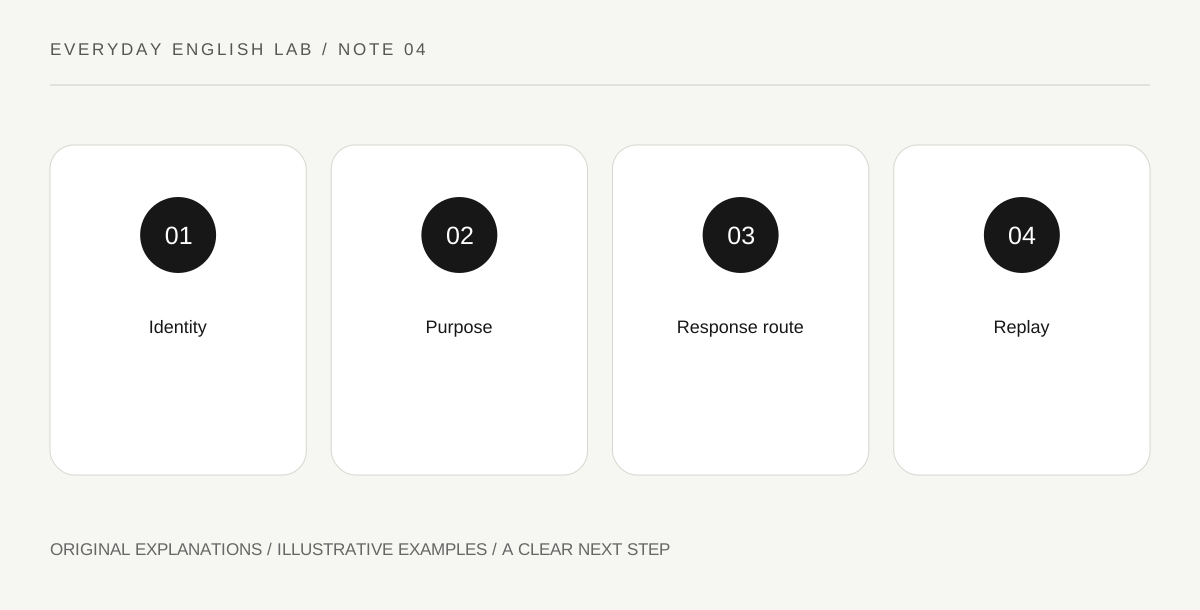
Original explanatory diagram. Read the full method and limitations below.
State your name and connection
Hello, this is Lena Park calling about the pottery class gives the listener both a name and context. A first name alone may be enough for a close friend but less useful for an unfamiliar office. Use a fictional identity for practice. Speak the first line at a comfortable pace, then pause briefly so the listener can separate your identity from the reason for the call.
Choose one main purpose
I would like to ask whether there is a place in the Saturday class is a focused reason. Avoid introducing three separate questions about prices, equipment and a different course in the same short practice message. You can ask those questions when you connect. One purpose makes it easier to decide what information the recipient needs before returning the call, which can lead to a more useful second conversation.
Give an explicit response route
Please call me back on the number I am calling from may work in some settings, but do not assume that the recipient can see or use that number. In a practice script, provide a clearly fictional callback number or ask the listener to reply through an already agreed channel. State when you are available if that changes the usefulness of the callback. Avoid reading real personal contact details into a shared exercise.
Replay for recoverability
Record a practice version and listen without looking at the script. Can you identify the name, class and callback request on the first hearing? If a number is included, group the digits and repeat it once. Do not repeat the whole message more loudly as a substitute for structure. A second learner can write down only the three essential details; differences between their notes and your intention show what to revise.
Illustrative worked example
Illustrative voicemail: Hello, this is Lena Park calling about the Saturday pottery class. I would like to know whether beginners can still join. Please call me back using the contact details in my registration inquiry. I am available tomorrow afternoon. Again, this is Lena Park, about the Saturday beginners' class. Thank you. In the exercise, the listener writes name, purpose and availability, then explains which detail was hardest to hear.
Questions that come up
Should I apologize for leaving a message?
Usually a greeting and a clear purpose are enough. You can be courteous without using several sentences to apologize for an ordinary voicemail.
What if I make a small grammar mistake?
Continue if the meaning remains clear. Restarting repeatedly can make a message harder to follow. If an essential detail was wrong, correct that detail explicitly.
References and scope
These sources support the factual background. Examples and exercises are original illustrative teaching material. References do not imply endorsement.
- British Council: Speaking practice — Situational speaking and interactive practice framework.
- British Council: Writing practice — Examples and practice for purposeful written communication.
- British Council: Listening practice — Listening activities organized by level and situation.