Move a plan from one day to another without losing the details
Changing a plan involves two separate pieces of information: the arrangement that currently exists and the replacement you propose. This lesson practises the move from one to the other, including what to say when your first alternative is unavailable.
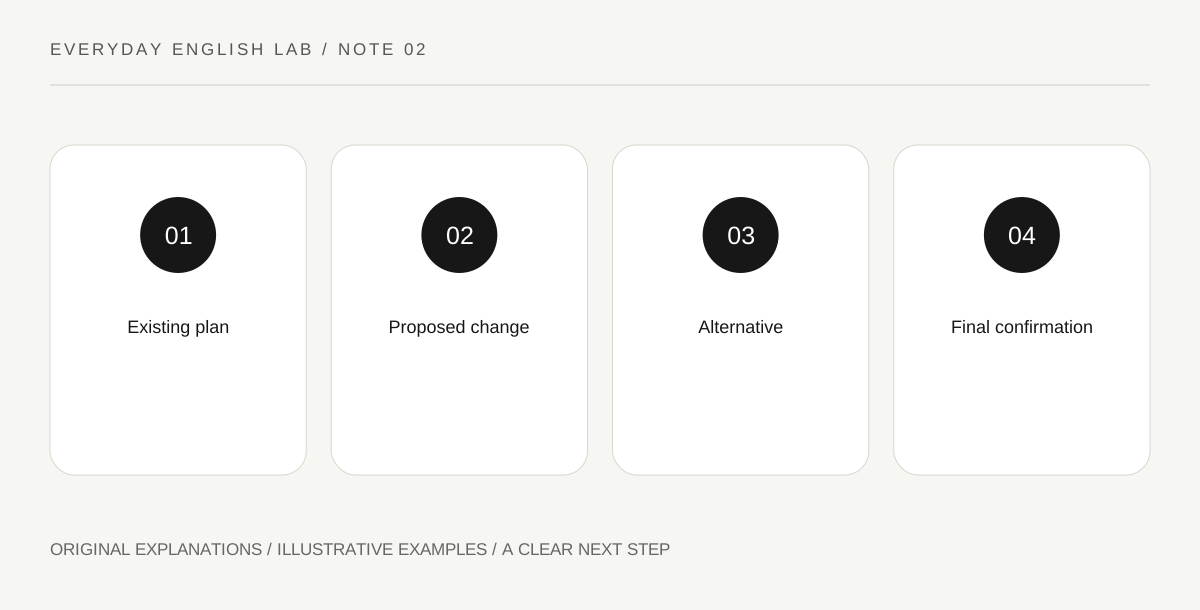
Original explanatory diagram. Read the full method and limitations below.
Identify the existing arrangement
Begin with enough context for your reader to recognize the plan: Could we move our Thursday lunch? If there are several meetings, add the time or subject. Avoid a bare Can we change it? when the message may be read hours later. The noun after move matters because the other person should not need to reconstruct which conversation you mean before considering your request.
Use from and to for the change
Could we move lunch from Thursday to Friday? marks the old and new positions clearly. A time can change independently: Could we keep Thursday but start at one instead of twelve? Practise these two changes separately before combining them. A sentence with both a different day and a different time asks the reader to hold more information, so a short follow-up confirmation becomes especially useful.
Offer a manageable alternative
Give one or two real possibilities: Friday at one works for me, or we could try Monday at noon. An unlimited Whenever you like may sound flexible while concealing your actual availability. In practice, use invented calendar entries and let your partner reject the first option. Your task is to respond naturally: Friday is difficult for me too. Would Monday work? A conversation includes negotiation, not only delivering a prepared line.
Confirm what survived the change
When a new time is accepted, restate the whole arrangement: Great, Monday at noon at the same cafe. If the place changes too, name it rather than adding there. You can then update your own calendar. In the exercise, the listener should be able to write the final day, time and place from your final message alone. That is a clearer success measure than whether every sentence sounds formal. Include the date if the week boundary could be misunderstood.
Illustrative worked example
Illustrative exchange: Could we move our Thursday lunch to Friday at one? Friday is full for me. How about Monday at noon? Monday works. Shall we keep the cafe by the station? Yes, please. Great, Monday at noon at Station Cafe. The two speakers changed the day twice but preserved a usable final plan. Now repeat with a different activity and have your partner ask whether the original location still applies.
Questions that come up
Do I need to explain the reason?
A brief reason may be helpful, but detailed personal information is optional. I have a schedule conflict is enough for many ordinary arrangements.
Is next Friday always clear?
It can be understood differently around the end of a week. Add the calendar date when that difference could cause confusion, especially in a message read later.
References and scope
These sources support the factual background. Examples and exercises are original illustrative teaching material. References do not imply endorsement.
- British Council: Speaking practice — Situational speaking and interactive practice framework.
- British Council: Writing practice — Examples and practice for purposeful written communication.