Explain a missing delivery with a short event timeline
When a parcel has not arrived, a clear sequence helps the other person find the problem. Practise separating what the tracking page said, what you personally observed and the action you are requesting. You can sound calm without hiding that you need help.
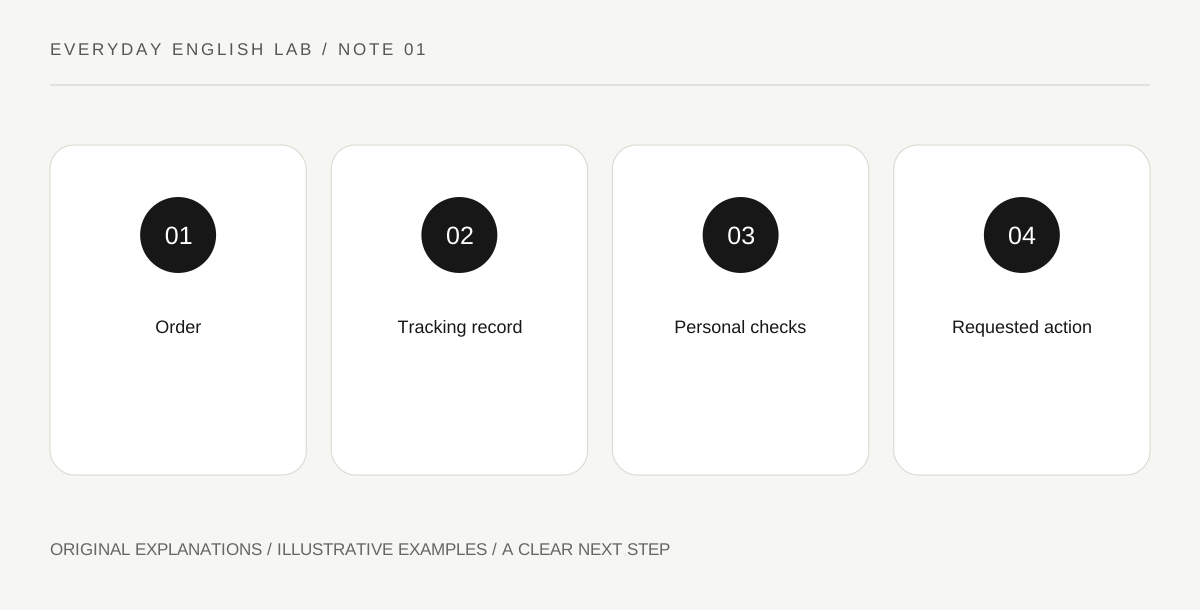
Original explanatory diagram. Read the full method and limitations below.
Choose three completed events
Start with a small timeline rather than every detail of the order. Use the past simple for finished events: I ordered the lamp on Monday. The tracking page marked it delivered yesterday. I checked the reception desk this morning. These sentences give a support worker distinct places to investigate. Avoid changing every sentence to the present because the problem still exists; completed actions and a current problem can appear together naturally.
Distinguish the record from your observation
The page says delivered is a report about a record. I received the parcel is a claim about your experience. Keep those meanings separate: The tracking page says it was delivered, but I have not received it. If you checked only the front door, say that rather than claiming you searched the whole building. Specific language makes the conversation more useful and avoids blaming a person whose role is still unknown.
Ask for an action with an answer
Could you check the delivery address? gives the listener a task. Where is it? expresses the concern but leaves the next step broad. You can follow with Can you tell me what happens next? if the first check does not resolve the issue. Practise giving an order reference from fictional practice material. Real account details belong only in the service’s appropriate private channel, not in a public classroom recording.
Close the loop before finishing
Repeat the agreed next step in your own words: So you will contact the carrier and email me tomorrow. Then ask one final question if something remains unclear: Should I reply to the same email? This is a comprehension exercise, not a demand to control the company’s process. Listen for who will act and when. A polite goodbye is easier when both people understand what the conversation actually achieved.
Illustrative worked example
Illustrative role-play: Mina says, I ordered a desk lamp on Monday. The page says it arrived yesterday, but I did not receive it. I checked reception this morning. Could you check which address was used? The agent replies, I will ask the carrier for the delivery record. Mina finishes, Thank you. Will you email me when you have that record? Notice that her story ends with a question the agent can answer.
Questions that come up
Must I use advanced complaint language?
No. Three accurate event sentences and a clear request are more useful than an elaborate accusation. Add detail when the listener asks for it.
What if I do not know the delivery date?
Say I do not know when it was delivered, or The page does not show a delivery time. Do not invent a time to complete the grammar exercise.
References and scope
These sources support the factual background. Examples and exercises are original illustrative teaching material. References do not imply endorsement.
- British Council: Past simple — Past simple forms for completed events.
- British Council: Speaking practice — Situational speaking and interactive practice framework.