Use since and for to explain an ongoing situation
A starting point and a length of time answer different questions. Practise using since and for with a situation that continues now, then contrast it with a finished period. A simple drawn timeline can keep the meaning ahead of the grammar.
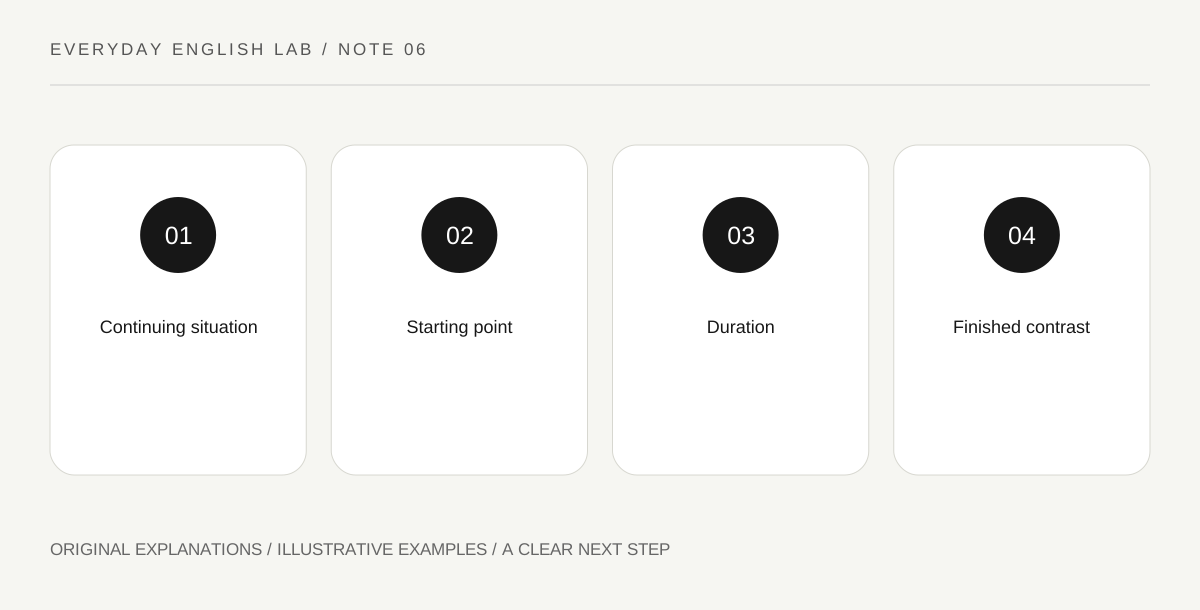
Original explanatory diagram. Read the full method and limitations below.
Mark now before adding the past
Draw a line with a clear now point. Place the start of a fictional situation to the left: a person started living in a town in March and still lives there. Say I have lived here since March. The word since points to the start. Do not begin by replacing random prepositions in a worksheet; decide first whether the situation reaches the present in your intended story.
Replace a date with a duration
For describes a length: I have lived here for six months. The town and person remain the same, but the time phrase measures the interval rather than naming its beginning. Practise pairs such as since Monday and for three days using an invented calendar. Exact agreement matters in the exercise: if you move now to another date, update the duration rather than keeping a memorized number that no longer fits. Count from the stated start to the stated present.
Contrast a finished stay
I lived there for six months describes a completed period in this practice context. I have lived here for six months connects the period to now. Changing there to here helps clarify the story, but the time relationship is the main lesson. Give your partner two short biographies and ask which person still lives in the town. Their interpretation tells you whether your sentence communicated the distinction you intended.
Answer a follow-up without changing the timeline
How long have you lived here? can receive For six months or a complete sentence. When did you move here? asks for a point: In March. Learners sometimes answer every time question with the same phrase, so practise the questions in an unpredictable order. Add one current observation, such as I know the neighborhood better now, to turn the grammar into a small conversation about a person’s experience.
Illustrative worked example
Illustrative practice: It is September in a fictional calendar. Arun moved to Maple Town in March and remains there. He says, I have lived here since March, or I have lived here for six months. His friend moved away last year and says, I lived there for six months. A partner asks each person when they moved and whether they still live there. Rewrite the sentences when the fictional calendar advances to November.
Questions that come up
Is since six months correct here?
Use for six months for a duration. Use since March or since I moved for a starting point that connects to the present.
Can I use for with the past simple?
Yes. For can describe the length of a completed period. The verb form and context show whether the situation continues now.
References and scope
These sources support the factual background. Examples and exercises are original illustrative teaching material. References do not imply endorsement.
- British Council: Present perfect — Present perfect form and its relation to the present.