Keep borrow and lend attached to the correct person
Borrow and lend describe the same temporary transfer from different directions. A practical object exchange makes the distinction easier to remember than memorizing two isolated translations. This lesson adds return arrangements so the whole interaction has a clear endpoint.
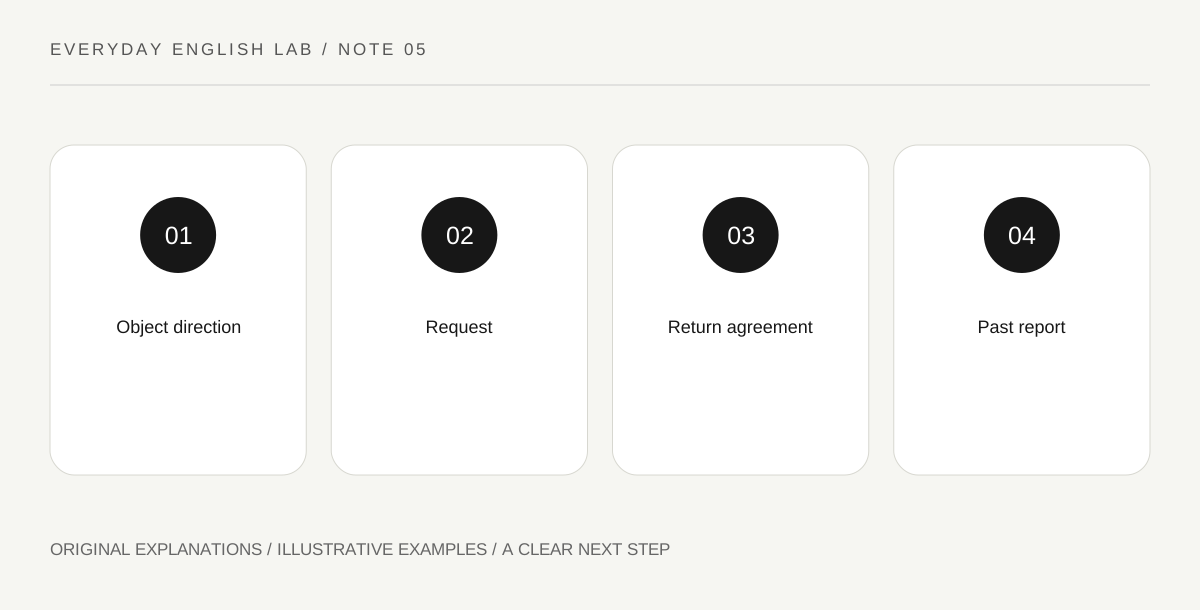
Original explanatory diagram. Read the full method and limitations below.
Draw the direction first
Place two names on paper and draw an arrow showing where the object moves. If Maya gives a book temporarily to Theo, Maya lends the book and Theo borrows it. The action has two perspectives. Say both sentences while pointing to the arrow. Do not change the people when you change the verb; keeping the event fixed helps reveal exactly what the different verb contributes. A second arrow can show the later return to the owner.
Ask from the receiving position
Could I borrow your umbrella? places the speaker as the temporary receiver. Could you lend me your umbrella? asks the owner to act. Both can describe the same request. Avoid Can you borrow me your umbrella? in standard practice because it mixes the verb’s direction with the wrong subject. Build two pairs with familiar objects, such as a charger and a notebook, before adding longer explanations.
Add an achievable return arrangement
Could I borrow your notebook until tomorrow? includes an endpoint. If the other person needs it sooner, negotiate: I can return it this evening instead. Use an actual or fictional day rather than soon when precision matters. The exercise is about language and consideration, not persuading someone to agree. A clear No, I need it today should remain a complete answer that the requester can acknowledge politely.
Use the past forms in a follow-up
Yesterday I borrowed Sam’s charger. Sam lent it to me for one evening. The forms borrowed and lent are different, so practise them inside complete sentences. Then add the completion: I returned it this morning. This final sentence distinguishes a temporary transfer from an object that is still away. A learner can retell the three events while a partner draws arrows to check who had the object at each stage.
Illustrative worked example
Illustrative dialogue: Could I borrow your ruler for this drawing? Yes, but I need it before lunch. I can return it at eleven. Is that early enough? Yes. Later, the learner reports, I borrowed Jo’s ruler this morning. Jo lent it to me until eleven, and I returned it before lunch. Change only the names and object on the first repetition; on the second, change the return arrangement and practise declining politely.
Questions that come up
Can borrow describe money?
Yes, but practise the grammar first with low-stakes objects. Money arrangements involve additional details that this language exercise does not resolve.
Is lend me or lend to me better?
You can say lend me the book or lend the book to me. Keep the complete pattern together rather than rearranging only one word.
References and scope
These sources support the factual background. Examples and exercises are original illustrative teaching material. References do not imply endorsement.
- British Council: Past simple — Past simple forms for completed events.
- British Council: Speaking practice — Situational speaking and interactive practice framework.