Use sentence emphasis to correct one detail
The same words can draw attention to different information. Practise emphasizing the part you are correcting while keeping the rest of the sentence understandable. This lesson uses ordinary scheduling and object descriptions so you can hear a difference in meaning without learning a new vocabulary list.
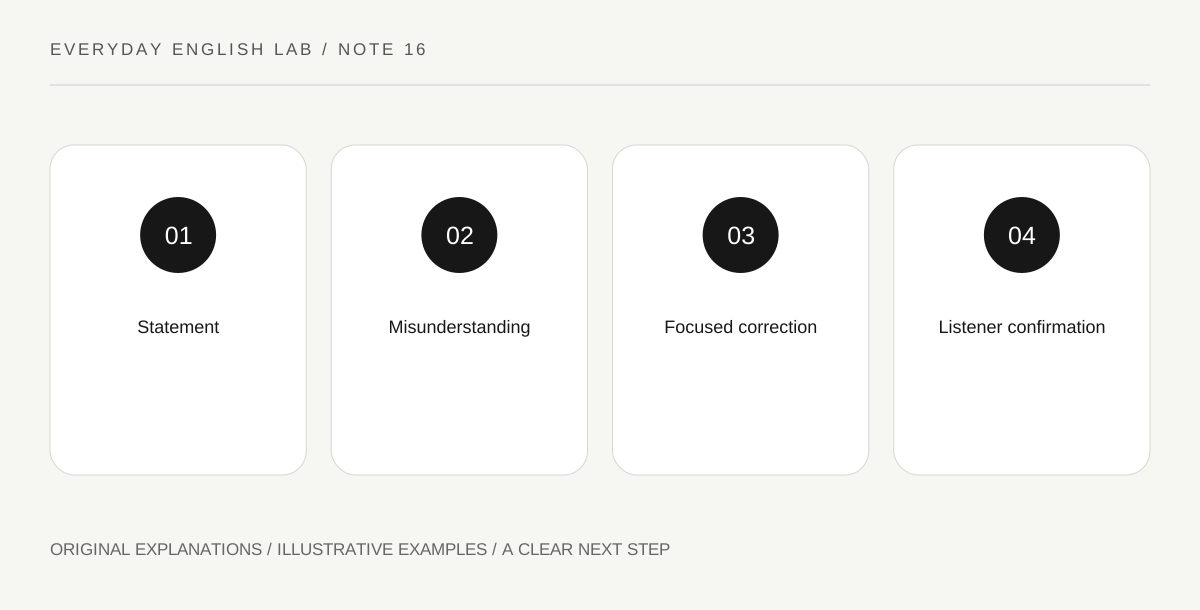
Original explanatory diagram. Read the full method and limitations below.
Choose the mistaken detail
Start with a short statement: We need the blue folder on Monday. Imagine that your partner misunderstood only the color. Your correction is We need the BLUE folder on Monday. If the day is wrong, emphasize MONDAY instead. The printed capitals are a practice cue, not a request to shout. Keep the words the same initially so you can hear what the change in emphasis contributes to the message.
Keep the correction friendly and complete
You can begin with a light clarification: I meant the blue folder, rather than the green one. This explicit wording is useful if emphasis alone does not resolve the misunderstanding. Tone and volume vary across speakers and situations, so do not assume that one exaggerated classroom pattern is the only natural way to speak. The listener’s understanding is the goal, and an extra clarifying phrase can support it.
Listen before choosing your emphasis
Have your partner repeat your sentence with one deliberate error. Identify whether they changed the person, object, place or time. Correct only that detail, then ask them to repeat the final meaning. This prevents mechanical practice in which every sentence receives the same stress pattern regardless of the misunderstanding. You are choosing an emphasis because of something the listener said, which makes the exercise a small interaction rather than a recital.
Compare two recordings
Record one correction in which every word is equally forceful and another in which the relevant word stands out. Listen for which version helps you identify the correction. Avoid scoring your accent against a single imagined ideal. A partner can state what changed without judging whether you sound like a particular region. Then try a fresh sentence with a different correction, so the skill transfers beyond the original blue folder example.
Illustrative worked example
Illustrative exchange: Speaker A says, Please bring the blue folder on Monday. Speaker B asks, The green folder on Monday? A replies, The BLUE folder on Monday. B then asks, The blue folder on Tuesday? A replies, The blue folder on MONDAY. Finally B states, Blue folder, Monday. The repetition looks similar on paper, but the listening task changes each time because a different detail needs repair.
Questions that come up
Can I use words instead of emphasis?
Yes. Say Monday, not Tuesday, or I meant the blue folder. Explicit clarification is useful when sound quality or familiarity makes emphasis hard to interpret.
Should every important word be strong?
If everything receives equal emphasis, the contrast may disappear. Choose the detail that matters in this particular correction and keep the rest intelligible.
References and scope
These sources support the factual background. Examples and exercises are original illustrative teaching material. References do not imply endorsement.
- British Council: Speaking practice — Situational speaking and interactive practice framework.
- British Council: Listening practice — Listening activities organized by level and situation.