Tell a short story with a clear turn in the middle
A short personal story needs more than a list of events. Practise an opening situation, an unexpected change and a result. Use an invented ordinary incident so you can focus on how the listener follows the story rather than on finding something dramatic to tell.
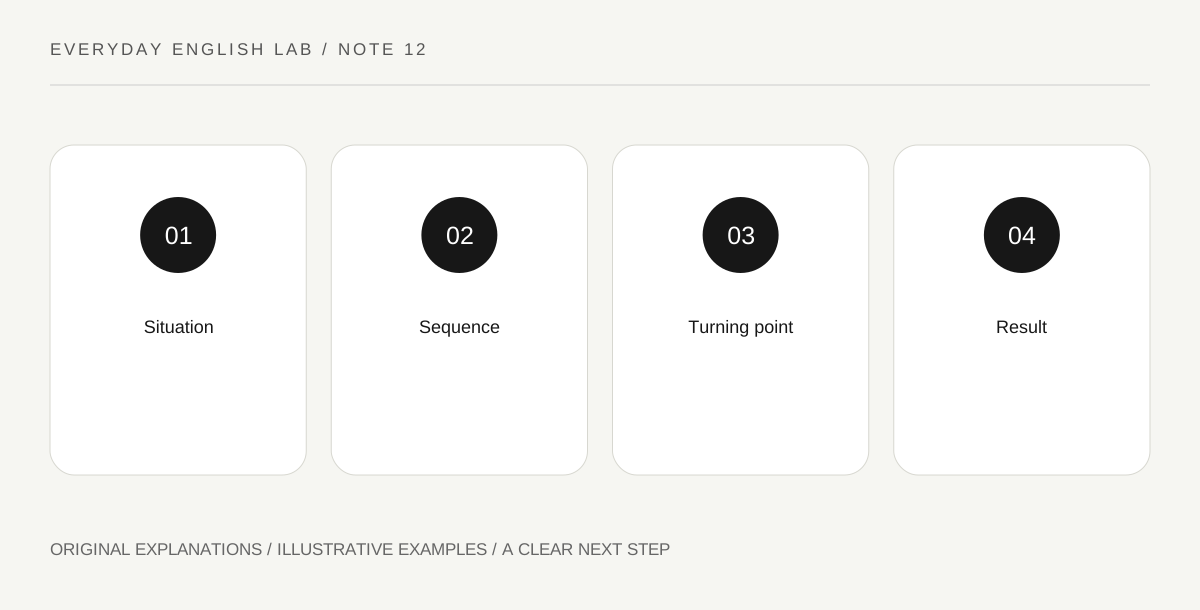
Original explanatory diagram. Read the full method and limitations below.
Set the scene with one useful detail
Last Saturday, I went to the market to buy ingredients gives the listener a time, place and purpose. You do not need every detail of the journey. Choose the information that explains why the later event matters. In an invented story about forgetting a shopping list, the list is relevant; the color of the bus seat probably is not. A clear opening gives later surprises something to change.
Connect events without repeating then
First and after that can help organize a sequence, but a story becomes tiring if every sentence begins the same way. Use ordinary connections where they fit: I reached the stall, but I could not find my list. The word but signals a turn. Practise speaking the same events once as separate sentences and once with one useful connection. Notice which relationship became clearer rather than simply counting linking words.
Keep the turning point visible
The central change might be I realized I had left my wallet at home. For an easier version, use I looked in my bag. My wallet was not there. You can tell the same event with grammar at different levels. Do not abandon the story because you cannot produce the most advanced tense. A listener needs a recognizable problem and consequence before they need an elaborate description of background time.
End with the result or reflection
I went home and cooked with what I already had completes the event. Now I keep a small list by the door adds a present habit linked to the experience. Avoid continuing into several unrelated stories after the main result. Ask a partner to retell your opening, problem and ending in three short sentences. If they cannot identify the change, revise that part rather than adding more adjectives to the introduction.
Illustrative worked example
Illustrative story: Last Saturday, I went to the market for ingredients. I reached the vegetable stall, but my shopping list was missing. I checked my bag and found a library receipt instead. I called my housemate, who read the list from the kitchen table. I bought what we needed and wrote a shorter list on my phone. A partner now retells only the purpose, obstacle and solution, then asks one follow-up question.
Questions that come up
Must my story be true for practice?
No. Label invented stories as fictional. Ordinary imagined events can provide useful speaking practice without exposing personal experiences.
How long should the story be?
Begin with a version your partner can follow in about a minute. Length is less important than a clear situation, change and ending.
References and scope
These sources support the factual background. Examples and exercises are original illustrative teaching material. References do not imply endorsement.
- British Council: Past simple — Past simple forms for completed events.
- British Council: Speaking practice — Situational speaking and interactive practice framework.