Report a suitcase that did not arrive at baggage claim
An airport baggage report combines a missing object, a journey and a description. Practise giving those details in a manageable order and asking what record or next instruction you need. This lesson teaches communication, while airline procedures vary by journey and carrier.
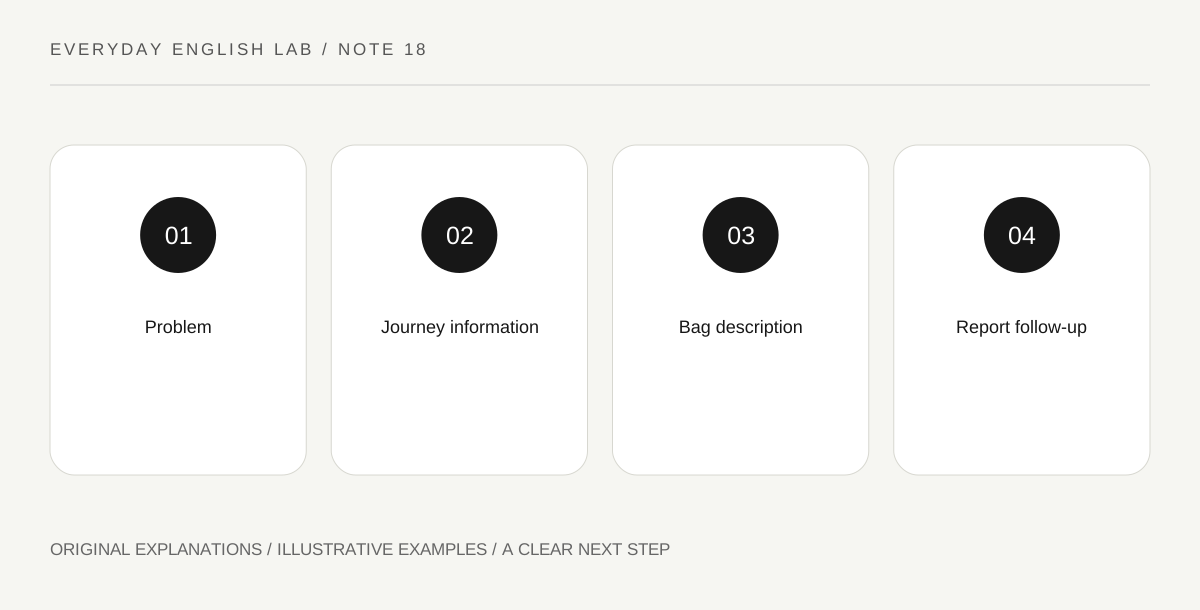
Original explanatory diagram. Read the full method and limitations below.
Open with the immediate problem
My suitcase did not arrive at baggage claim tells a staff member why you are speaking to them. Add the flight or journey information requested through the appropriate channel. In a role-play, use invented references and locations. Avoid beginning with a long account of your whole trip before the listener knows the problem. A concise opening lets them direct you to the right process or ask the first relevant question.
Give a recognizable bag description
It is a medium-sized navy suitcase with a red strap gives three useful features. The strap is especially helpful if many bags have the same basic color. You can add a mark or tag when asked, but keep personal label information private in a shared exercise. Practise with several suitcase pictures and let the listener identify the correct one without pointing. This shows whether your chosen details distinguish the bag.
Understand the paperwork questions
You may be asked for a baggage reference or contact details through the carrier’s process. If you do not understand a term, ask Is that the number on this baggage receipt? rather than guessing. Language learning is not a reason to disclose details in an unsuitable public setting. A classroom worksheet can show fictional documents so you practise locating the requested item while preserving real information outside the exercise.
Ask what happens after the report
Could I have the report reference? and How should I check for updates? are questions with practical answers. Repeat the communication method and any instruction you receive. Do not assume an estimated arrival is a guarantee or invent a delivery promise in the script. In the practice dialogue, the learner should finish knowing which reference identifies the report and where to find the next update, even if the bag has not yet been located.
Illustrative worked example
Illustrative role-play: My suitcase did not arrive. It is medium-sized and navy, with a red strap. Here is the fictional baggage receipt from our worksheet. The staff partner asks for a practice reference and explains that a report will be created. The learner asks, How can I check for updates, and which number should I quote? The partner provides an invented report reference. Both then summarize the agreed update method without inventing a recovery time.
Questions that come up
Should I memorize a particular airline procedure?
No. Learn to ask for and understand the process that applies to your actual journey. The dialogue should adapt to the staff member’s answer.
Can I say luggage instead of suitcase?
Yes, luggage is a general category. Use suitcase or bag when describing a particular item, which can make the description more concrete.
References and scope
These sources support the factual background. Examples and exercises are original illustrative teaching material. References do not imply endorsement.
- British Council: Past simple — Past simple forms for completed events.
- British Council: Speaking practice — Situational speaking and interactive practice framework.