Describe a lost object so someone can distinguish it
A lost-property description should help someone choose one object from several similar ones. Practise moving from a general noun to distinctive features, then explaining when you last had the item. Use fictional objects and details when sharing practice recordings.
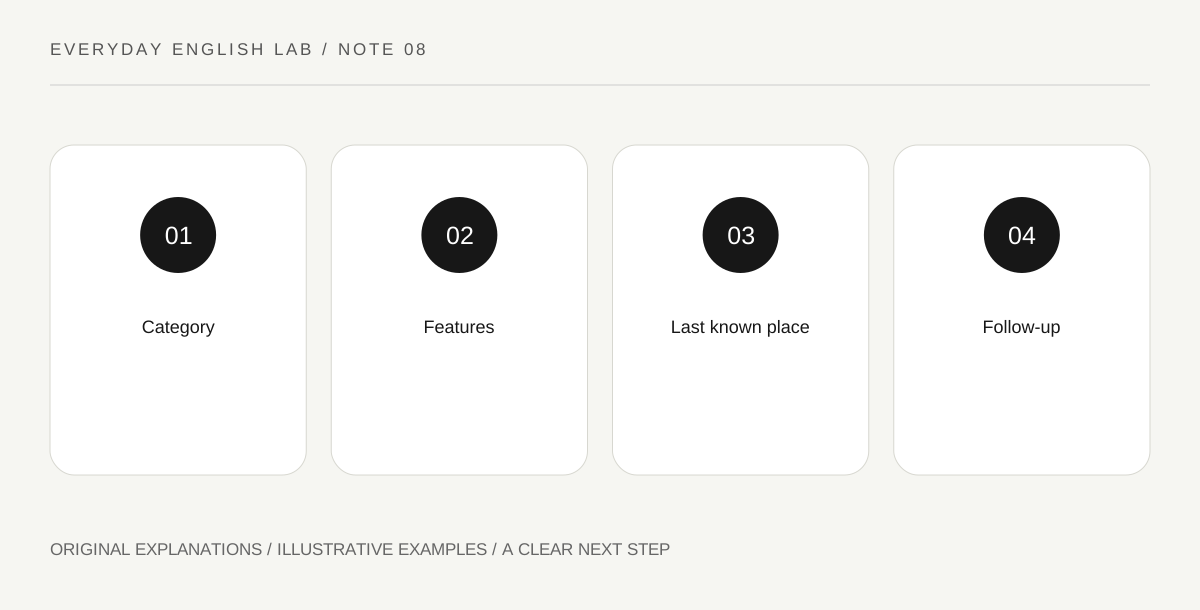
Original explanatory diagram. Read the full method and limitations below.
Start with the object category
I am looking for a water bottle gives the listener a useful starting category. Then choose two distinguishing features: It is dark green with a silver lid. Listing every tiny mark at once can make the main description harder to remember. Let a partner draw a quick sketch from your first two sentences. If the sketch matches a different object, adjust the most useful feature rather than adding unrelated information.
Use a short identifying clause
It is the bottle that has a yellow sticker near the handle helps separate it from other green bottles. The clause after that identifies which object you mean. You can also say It has a yellow sticker near the handle; the simpler sentence may be easier at first. Practise both versions with the same object so that you connect the grammar to its identifying job rather than treating it as decoration.
Describe the last known place
I last had it in the upstairs reading room is more careful than I lost it in the reading room if you do not know where the loss happened. Add a finished event: I put it beside my bag before the workshop. The distinction matters because a helpful listener may need to search several places. Keep your certainty aligned with what the fictional scenario actually tells you.
Ask how identification will work
If someone finds a possible match, ask Could you tell me whether it has a dent near the base? In practice, reserve one detail for a follow-up rather than stating everything in the opening. Ask where to check next if it has not been found. Avoid giving public access codes, real addresses or sensitive identifying information in a shared language exercise. The goal is a recognizable object and a clear next step.
Illustrative worked example
Illustrative task: Three fictional bottles appear on a worksheet: a green bottle with a black lid, a green bottle with a silver lid and a blue bottle with a silver lid. The lost bottle has a silver lid and a yellow mountain sticker. The learner describes it without pointing, then says where it was last seen. Their partner selects the matching drawing and asks one question about a reserved detail before confirming the match.
Questions that come up
Do I need relative clauses immediately?
No. Several short accurate sentences can communicate the same description. Add the clause when it helps connect an identifying feature naturally.
What if I do not know the English object name?
Describe its purpose and shape: the small thing used to hold keys together. Then ask What is that called? and reuse the new word.
References and scope
These sources support the factual background. Examples and exercises are original illustrative teaching material. References do not imply endorsement.
- British Council: Past simple — Past simple forms for completed events.
- British Council: Relative pronouns and clauses — Identifying relative clauses for people and things.