Describe a purchase problem before requesting a return
A return conversation becomes easier when you describe the item and its problem before asking what options are available. Practise observable details, simple past events and a specific request. This is language practice; store policies and consumer rights depend on the situation.
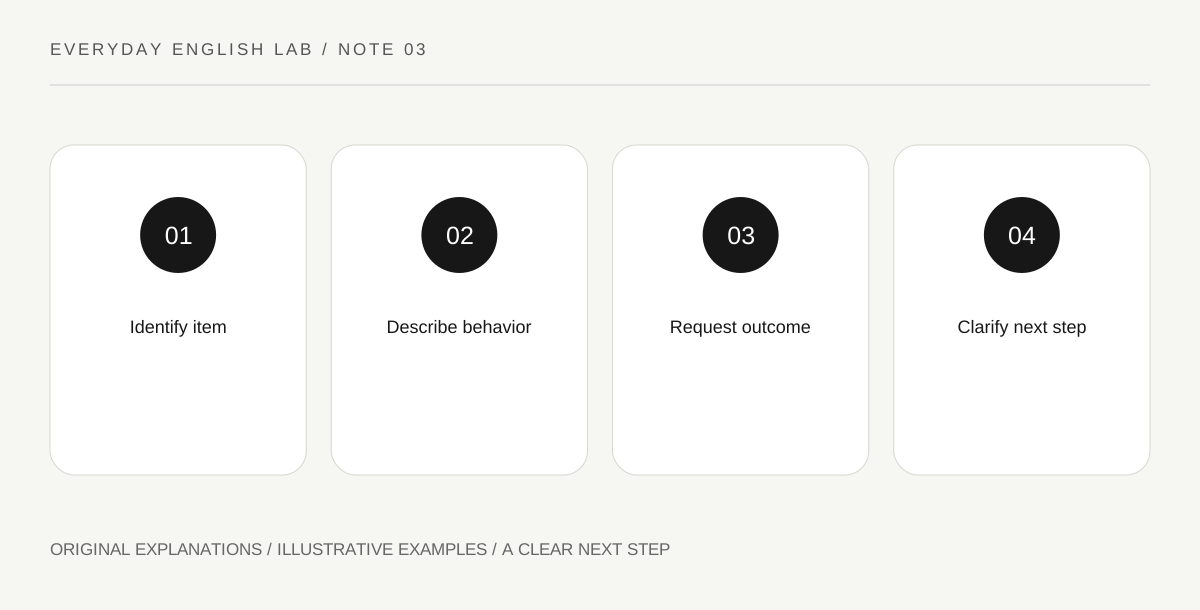
Original explanatory diagram. Read the full method and limitations below.
Point to the exact item
I bought these headphones here on Saturday identifies an object, place and finished event. If you are writing, add the product description or relevant reference through the store’s appropriate channel. This one sentence is more informative than I have a problem with something I bought. Let your partner ask Which pair? so you practise identifying the item again without becoming stuck when the prepared opening is interrupted.
Describe what happens
Choose a behavior you can explain: The left side does not produce any sound. It works for a minute and then switches off. Avoid broken if you can give a more precise observation. You do not need to diagnose the technical cause. If you tried a normal setup step, add I tried another cable, but the problem continued. Keep the difference between observation and diagnosis visible in your wording.
Name your preferred outcome
Could I return them for a refund? asks for one outcome. Could I exchange them for another pair? asks for another. These are useful alternatives rather than interchangeable phrases. If you are unsure, ask What options are available? In a role-play, have the assistant explain an option you did not expect. Practise a pause and a follow-up question instead of agreeing simply because you understood one familiar word.
Check the next practical step
Listen for whether you need to bring packaging, wait for an inspection or complete a form. Reflect back the instruction: So I should bring both earpieces and the charging case? A question with both tells you whether the set must remain together. Finish by asking how the result will be communicated if the process continues later. You are learning to leave with a usable instruction, rather than merely finishing the conversation politely.
Illustrative worked example
Illustrative role-play: I bought these headphones on Saturday. The left side has no sound. I tried the normal pairing steps, but it still does not work. Could I exchange them? The assistant says the store first needs to inspect the complete set. The learner replies, Do you need the charging case as well? After the answer, the learner repeats what to bring. The example assumes no particular entitlement or store policy.
Questions that come up
Can I say It is faulty?
Yes, but add a concrete description when possible. A listener can investigate no sound from the left side more easily than an unexplained judgment.
What if the assistant uses an unfamiliar policy word?
Ask What does that mean for my return? or Could you explain the next step? You can request plain language without pretending to understand the term.
References and scope
These sources support the factual background. Examples and exercises are original illustrative teaching material. References do not imply endorsement.
- British Council: Past simple — Past simple forms for completed events.
- British Council: Speaking practice — Situational speaking and interactive practice framework.