Practise regular past endings through sounds rather than letters
Regular past-tense verbs share the written ending ed, but that ending does not always add an extra syllable. Practise a few contrasting words in short messages, listening to the final sound of the base verb before choosing the ending.
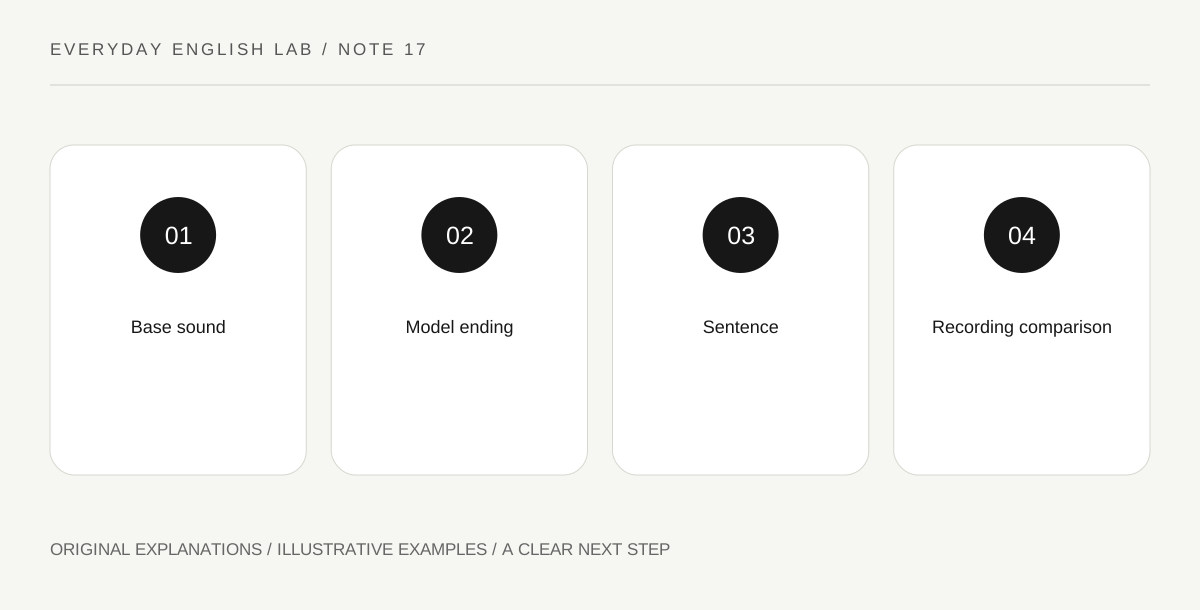
Original explanatory diagram. Read the full method and limitations below.
Begin with a small listening set
Use a reliable pronunciation model for a few words such as worked, played and wanted. Listen to each word inside a short sentence, then notice whether it has an extra syllable compared with work, play or want. Do not build a long list before you can hear the difference in a small set. A focused comparison gives you something specific to imitate and check during the next repetition.
Notice the final sound of the base
In common standard descriptions, the ending is pronounced differently after different final sounds. After the t sound in want, wanted adds a syllable. After the d sound in need, needed does too. The spelling of the earlier letters is not the main guide. Treat this as a sound task: say the base, listen to its end and then listen to the past form in a trustworthy model.
Keep the ending inside a useful sentence
I worked late yesterday and I played tennis yesterday make the past action meaningful. Avoid adding an extra vowel solely because the letters e and d are visible. Practise slowly enough to preserve the ending, then return to a comfortable conversational pace. A recording can show whether the ending disappears when you speak faster. The aim is intelligible tense information, not a dramatic performance of each individual consonant.
Use a short correction cycle
Choose three past-tense sentences, record them and compare only the target endings with the model. Revise one word at a time. Then change the surrounding sentence while keeping the verb: I worked at home on Friday. This tests whether you can carry the pronunciation into a new context. If a word remains difficult, ask a teacher or suitable pronunciation resource for help rather than deriving every sound from its spelling.
Illustrative worked example
Illustrative practice message: Yesterday I worked at home, played a short game after dinner and wanted to finish a book before bed. The learner first records the three verbs separately, then records the message. A partner marks which past forms were easy to recognize without seeing the script. They compare a reliable model for worked, played and wanted, then repeat with needed, watched and cleaned in different fictional sentences.
Questions that come up
Does ed always sound like a separate word?
No. In many regular past forms it joins the existing final sounds without adding a full syllable. Listen to a model rather than pronouncing the letters separately.
Do irregular past forms follow this pattern?
This lesson concerns regular ed endings. Irregular forms such as went or bought need their own pronunciation practice and should not be forced into the same rule.
References and scope
These sources support the factual background. Examples and exercises are original illustrative teaching material. References do not imply endorsement.
- BBC Learning English: Pronunciation of ed endings — Regular past endings and final-sound pronunciation distinctions.