Offer an alternative when a suggestion does not work
Saying no to one suggestion does not require ending the conversation. Practise acknowledging the idea, explaining a practical obstacle and offering another workable option. The useful outcome is a choice both speakers understand, including the possibility that no shared option works today.
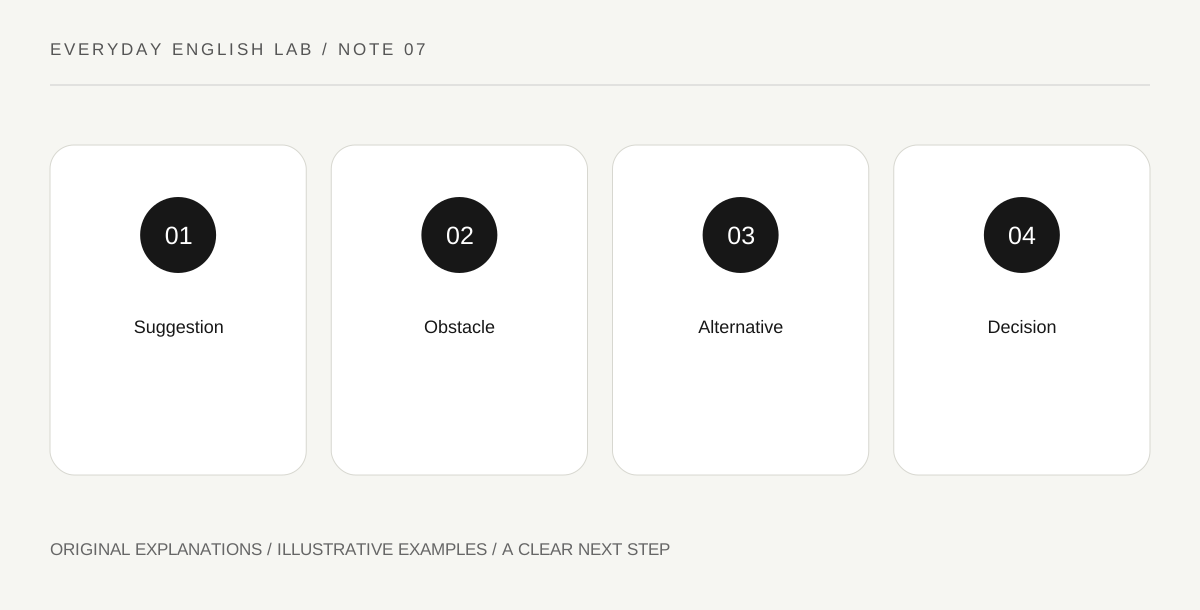
Original explanatory diagram. Read the full method and limitations below.
Name the part that does not work
That time is difficult for me is more precise than That is bad. It locates the obstacle in the arrangement without judging the other person’s idea. You can add a short reason: I finish work at six. Avoid inventing a long excuse to make your English sound persuasive. In a role-play, a simple factual constraint gives your partner something concrete to respond to.
Build an alternative with could
We could meet after seven presents a possibility. How about meeting on Sunday? introduces another suggestion with a different form. Practise each pattern as a complete chunk: could plus the base verb, and how about plus the activity form used here. Choose familiar activities so that deciding what to propose does not consume all your attention. The grammatical pattern should support the conversation, not become its entire purpose. Ask your partner which option fits their fictional calendar.
Show what your alternative preserves
If the original idea was to visit an exhibition together, meeting at another time may preserve the shared activity. Replacing it with an unrelated activity changes more of the plan. Say Would you rather change the day or do something else? when you need to understand the other person’s priority. This additional question prevents a chain of rejected suggestions that never identifies what either person actually wants.
Recognize an unresolved ending
Sometimes no option works. We cannot find a time this week. Shall we try again next month? gives the conversation an honest endpoint. Do not treat agreement as the only sign of successful language practice. A clear and respectful refusal can communicate well too. After the exercise, each speaker should state the obstacle, the alternatives considered and whether a plan was made, using their own words rather than quoting the script.
Illustrative worked example
Illustrative dialogue: Shall we visit the gallery at four? Four is difficult because I finish work at six. We could go on Sunday instead. I am away on Sunday. Would you rather choose another evening or leave it until next week? Next week is better. Okay, let us compare our calendars tomorrow. The speakers did not produce an immediate booking, but they understood the limitation and agreed on the next conversation.
Questions that come up
Does could mean I promise to do it?
In this suggestion pattern, could presents an option. Confirm acceptance separately instead of assuming that mentioning an option creates a final arrangement.
How do I reject the alternative too?
You can say That does not work for me either, followed by another option or a clear statement that you cannot join this time.
References and scope
These sources support the factual background. Examples and exercises are original illustrative teaching material. References do not imply endorsement.
- British Council: Speaking practice — Situational speaking and interactive practice framework.