Explain a past work task with an action and a result
When someone asks about previous experience, a list of job titles may not show what you did. Practise one short explanation of a task, your contribution and its result. Use a fictional project if you are learning in a public group.
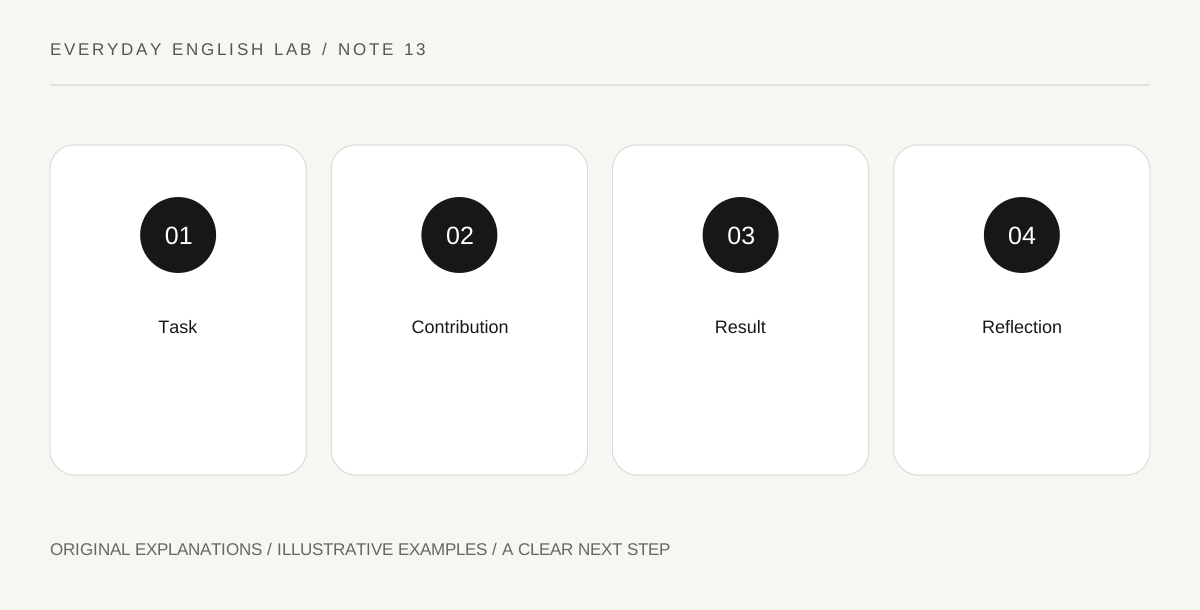
Original explanatory diagram. Read the full method and limitations below.
Choose a bounded task
I helped organize a weekend book exchange is easier to explain than I was responsible for everything. Pick a task with a recognizable beginning and end. Name the setting only as much as the listener needs: a club, a class or a workplace project. You can practise work language through a volunteer activity without inventing employment credentials. The point is to describe an action clearly, not make the experience sound prestigious.
Use verbs that identify your contribution
I created the sign-up sheet, contacted volunteers and labeled the boxes shows three actions. We organized the event describes the team result but may leave your own contribution unclear. Both perspectives can appear together: Our group ran the event, and I managed the sign-up sheet. Be accurate about ownership in a real conversation. Language practice should not encourage claiming that a team’s work was completed by one person.
State a result you can support
All the volunteer shifts were filled before the event is a specific result in the fictional example. It was incredibly successful is a judgment that may require explanation. If no numerical result is available, describe a concrete change: The new labels made it easier to sort the donated books. Do not invent percentages because numbers sound professional. A modest observable outcome communicates more reliably than a dramatic unsupported achievement.
Prepare one question about the process
A listener may ask What was difficult? or What would you change? Practise an answer that stays connected to the same task: We received some books late, so next time I would set an earlier drop-off date. This adds reflection without abandoning the example. A partner can ask one unexpected follow-up so you learn to discuss the experience rather than recite a speech that works only when uninterrupted.
Illustrative worked example
Illustrative answer: I helped organize a neighborhood book exchange. Our group arranged the venue, and I created the volunteer sign-up sheet. I checked the gaps each evening and contacted people who had offered to help. Every shift was covered before the event. Next time, I would set an earlier deadline for donations because sorting the final boxes took longer than expected. The answer identifies the team, personal actions, result and one specific improvement.
Questions that come up
Can I use a classroom project?
Yes. Name it accurately as a classroom project and explain your actions. Practical language does not depend on claiming formal employment.
What if the result was disappointing?
Explain what happened and what you learned. A clear account of a difficulty can demonstrate communication better than an invented success story.
References and scope
These sources support the factual background. Examples and exercises are original illustrative teaching material. References do not imply endorsement.
- British Council: Past simple — Past simple forms for completed events.
- British Council: Speaking practice — Situational speaking and interactive practice framework.