Disagree about an idea without pretending to agree
Clear disagreement can remain courteous. This lesson practises recognizing another person’s point, stating your different view and explaining one reason. You do not need an elaborate expression or a false agreement before you are allowed to express a different preference.
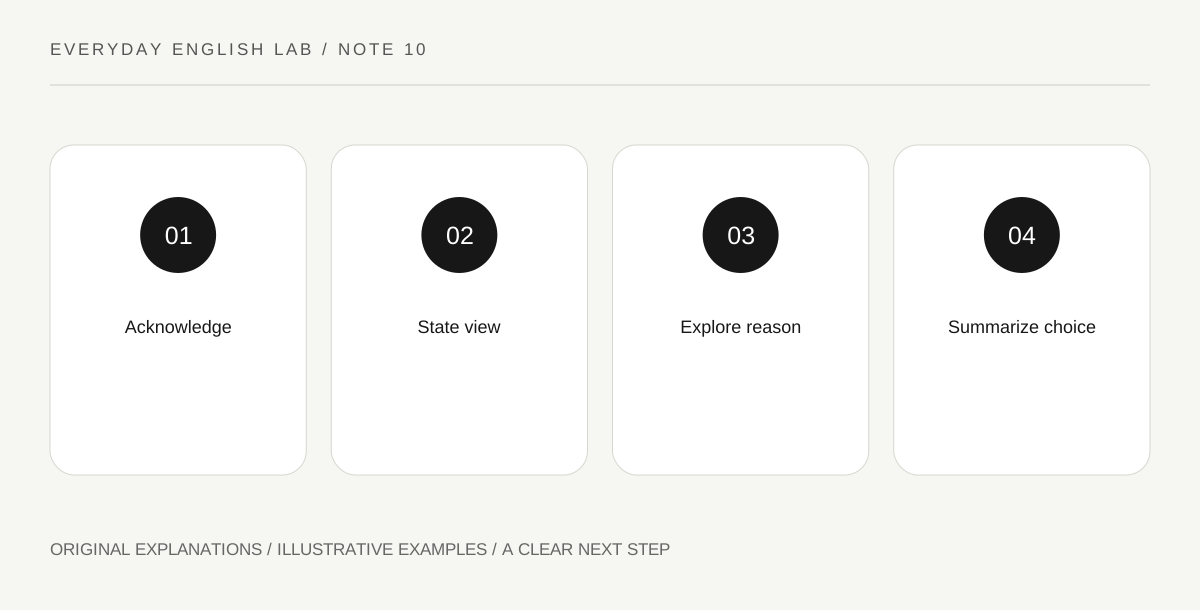
Original explanatory diagram. Read the full method and limitations below.
Separate understanding from agreement
I see what you mean acknowledges that you understand an argument. It does not necessarily mean you accept the conclusion. Follow it with your own view when needed: I see what you mean, but I think the smaller venue would work better. Avoid using Yes repeatedly if your real response is no. Your partner should be able to identify your position without decoding several contradictory polite phrases.
Give one relevant reason
The smaller room would be easier for our group to hear in connects your opinion to the shared task. I just do not like it may honestly express a preference, but it does not explain a practical concern. In a planning role-play, choose one factor such as travel time, seating or cost. Keep the reasoning proportional to the decision. You do not need to defend every personal taste as an objective fact.
Ask about the difference that matters
How important is the extra space to you? can reveal why the other person prefers the larger room. Asking a real question gives the discussion another direction besides repeating arguments. Listen for whether the disagreement concerns a fact, a priority or a personal preference. Those require different responses: checking information, comparing priorities or acknowledging that people enjoy different things. Practise naming the distinction in simple language after the exchange.
Summarize the remaining choice
So the larger room gives more space, and the smaller room is easier to reach. Which matters more for this event? brings the discussion back to a decision. If you still disagree, say I understand your reason, but I still prefer the smaller room. Courtesy does not require manufacturing a shared conclusion. The exercise succeeds when both speakers can explain the other’s reason accurately, even if their preferred choices remain different.
Illustrative worked example
Illustrative dialogue: I think we should meet at the riverside venue. I see the appeal, but I prefer the station venue because several people will arrive by train. The riverside room has more space. How much extra space do we need for this group? The speakers then check their fictional guest list. Their disagreement becomes a question about the event rather than a contest about whose taste is correct.
Questions that come up
Is I disagree always rude?
No. Tone, context and the explanation matter. I disagree about the start time can be clear and appropriate, especially when followed by a relevant reason.
What if the issue is only personal taste?
You can say I prefer the quieter option. A preference does not require proving that the other person’s enjoyment is mistaken or inferior.
References and scope
These sources support the factual background. Examples and exercises are original illustrative teaching material. References do not imply endorsement.
- British Council: Speaking practice — Situational speaking and interactive practice framework.