Give useful feedback on a shared piece of work
Feedback becomes easier to act on when it points to a specific part of the work and explains the reader’s experience. Practise describing one useful feature, one difficulty and one possible revision without turning a comment into a judgment about the writer.
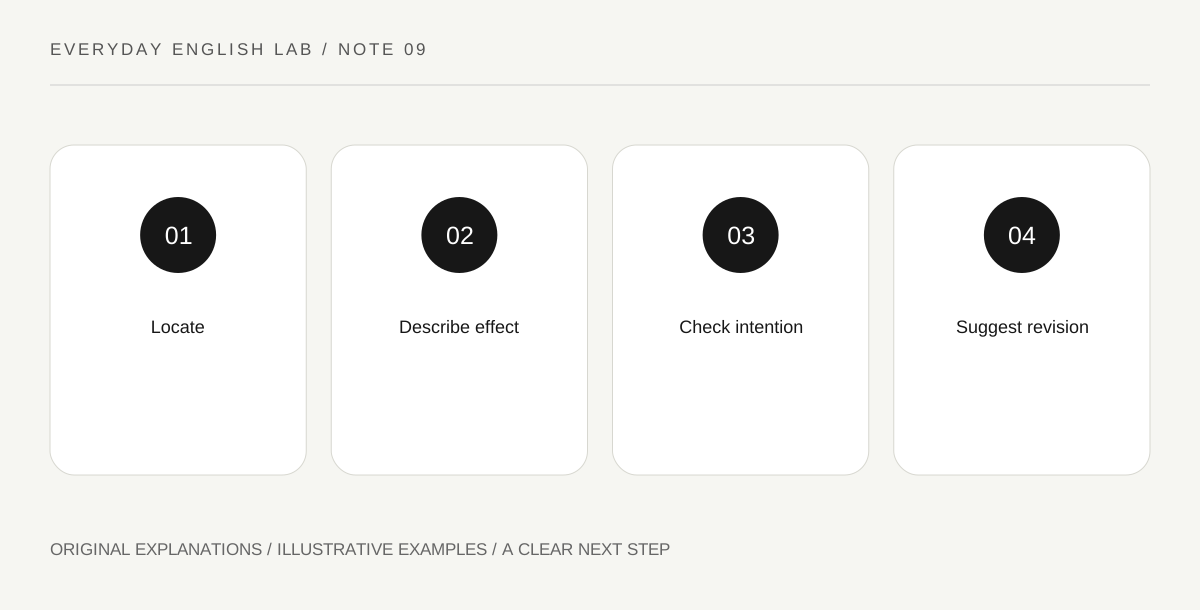
Original explanatory diagram. Read the full method and limitations below.
Locate the feature before evaluating it
The opening paragraph explains the event clearly tells your partner which part worked. Good job is friendly but gives little information about what to keep. Point to a sentence, heading or example in a fictional draft. You can say I understood the main point from the first two lines. This describes your reading experience and offers the writer a concrete reason to preserve that part during revision.
Describe a difficulty as your experience
I was not sure who they referred to in the second paragraph identifies a comprehension problem. You are not claiming that every reader must be confused. Compare that with Your writing is confusing, which leaves the writer guessing where to begin. Read the uncertain phrase aloud if appropriate, then explain the two meanings you considered. This can reveal an ambiguity that a general negative adjective would hide. Quote the ambiguous phrase when needed.
Offer a revision as an option
Could you name the team again in that sentence? proposes a small change tied to the problem. You might also say One option is to split this sentence. Use a possibility rather than issuing an instruction when the writer owns the decision. Practise giving only one change at first. A long list of edits can make it hard to distinguish the main communication problem from minor style preferences.
Check the writer’s intended meaning
Ask Did you mean the organizers or the visitors? before rewriting an ambiguous statement yourself. If the writer explains a different intention, revise your suggestion. In the role-play, the writer should summarize the feedback and choose an action: I will name the organizers again. This completes a useful exchange because the revision remains connected to the writer’s purpose rather than merely satisfying the person giving comments.
Illustrative worked example
Illustrative exchange: I understood the event date from your first sentence. In the next paragraph, I was not sure who they referred to. Did you mean the volunteers or the visitors? I meant the volunteers. Could you use the volunteers again there? Yes, that would make it clearer. The feedback names a successful detail, locates one difficulty and suggests a specific change after checking the intended meaning.
Questions that come up
Should I always begin with praise?
There is no requirement to manufacture praise. A genuine observation about what worked is useful when it helps the writer identify what to preserve.
How can I receive feedback?
Try Let me check that I understand: you were unsure who they meant. Then ask a clarifying question or explain your intention before deciding how to revise.
References and scope
These sources support the factual background. Examples and exercises are original illustrative teaching material. References do not imply endorsement.
- British Council: Speaking practice — Situational speaking and interactive practice framework.
- British Council: Writing practice — Examples and practice for purposeful written communication.