Keep a casual conversation going with one connected question
A follow-up question works best when it connects to something the other person has just said. Practise listening for one detail, asking about it and sharing a small related response. The goal is a balanced exchange rather than a sequence of unrelated interview questions.
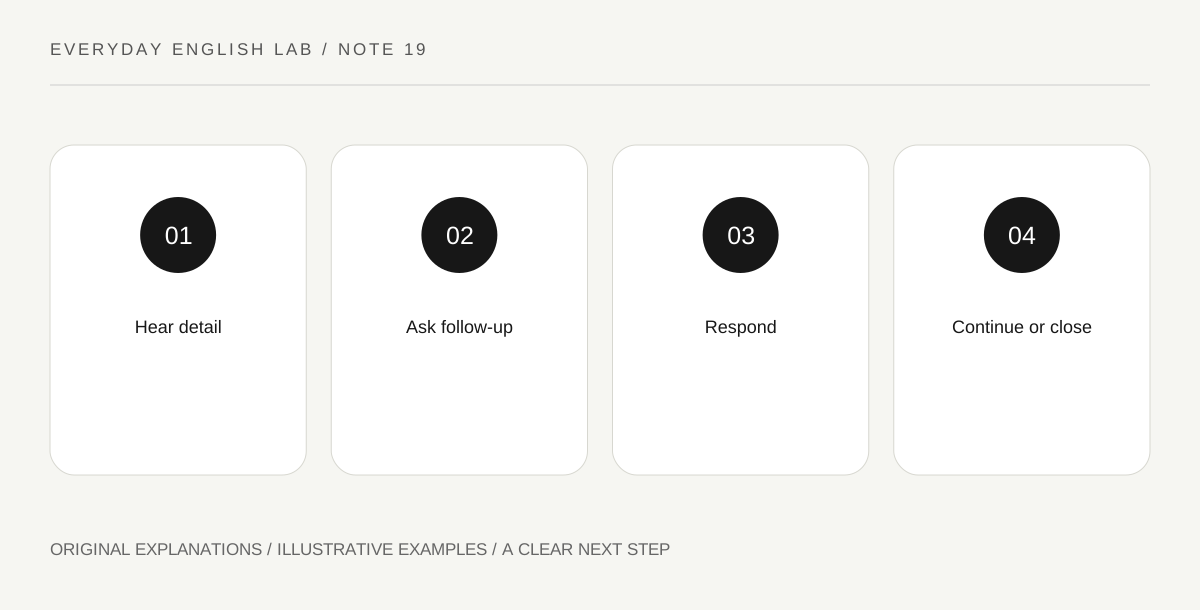
Original explanatory diagram. Read the full method and limitations below.
Choose a detail you actually heard
If someone says I started a ceramics class last month, you could ask What are you making? or How did you choose that class? Both connect to the statement. An unrelated Where do you live? abruptly changes the subject. In practice, have a partner mention an ordinary activity and write down one detail before responding. This small pause trains you to use the answer rather than merely wait for your turn.
Ask a question with room for an answer
What do you enjoy about it? invites an explanation. Do you like it? can be useful too, especially when the other person prefers a shorter response. Avoid assuming that every conversation requires a deep personal story. Choose a question appropriate to the relationship and setting. A casual exchange about a hobby does not require asking about income, health or private family matters unless the person chooses to introduce them.
Respond to the answer before moving on
If the person says they enjoy working with clay, acknowledge that detail: It sounds very hands-on. You can add a small related comment: I like making things too, although I have only tried paper crafts. This gives the other person something to respond to. Keep the contribution short enough that their original topic remains visible. Sharing is different from replacing their experience with a much longer story of your own.
Recognize a natural ending
Short answers, attention to another task or a clear goodbye may signal that the exchange is ending. You can say It was nice hearing about the class. I hope your bowl turns out well. Do not treat continuous questioning as the only measure of success. In a role-play, one person can choose to continue and another can choose to end. Practise responding respectfully to both outcomes rather than forcing the same script every time.
Illustrative worked example
Illustrative exchange: I started a ceramics class last month. What are you making? A small bowl, although it is still uneven. That sounds fun. What do you enjoy about the class? Working with my hands after a day at a screen. I can understand that; I enjoy paper crafts for a similar reason. The speakers now have a shared point, but either can still close the conversation naturally when their next activity begins.
Questions that come up
Do I need to ask why?
No. What, how and which questions can be useful alternatives. Choose the question that fits the detail and the other person’s willingness to talk.
What if I know nothing about the hobby?
Say I have never tried that. What is it like? Honest curiosity gives you a useful opening without pretending to have experience you lack.
References and scope
These sources support the factual background. Examples and exercises are original illustrative teaching material. References do not imply endorsement.
- British Council: Speaking practice — Situational speaking and interactive practice framework.
- British Council: Listening practice — Listening activities organized by level and situation.