Handle a phone connection problem without restarting everything
A poor phone connection can make familiar English feel unfamiliar. Practise identifying the missing part, requesting a targeted repeat and changing the communication channel when appropriate. The skill is to repair the conversation with enough detail for the other speaker to help.
Original explanatory diagram. Read the full method and limitations below.
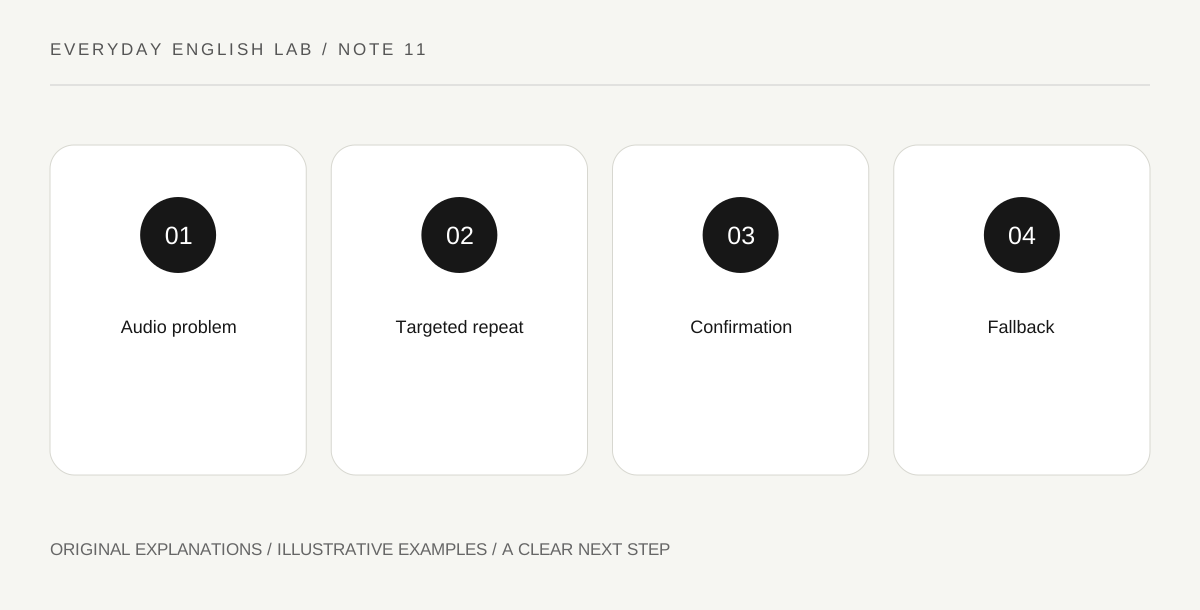
Describe the audio problem accurately
The line is breaking up means the sound is intermittent. I cannot hear you clearly describes a broader difficulty. I missed the last word identifies a much smaller gap. Choose the phrase that matches the exercise rather than saying I do not understand every time. A partner can deliberately omit one piece of a sentence, letting you practise requesting only the information you actually missed.
Request a smaller repeat
Could you repeat the street name? is easier to act on than Can you say everything again? If you heard part of the message, include it: I heard Tuesday, but I missed the time. This shows the listener what has already arrived successfully. Practise a sentence with a day, activity and room number, then have your partner ask for one component. Repeating the entire script should not be the only available response. Keep your request focused.
Confirm the recovered detail
Did you say fifteen or fifty? makes the possible confusion explicit. If necessary, ask the speaker to say the digits separately or spell a word. Repeat the final interpretation once: Room one-five, correct? The confirmation should reflect the exact information at issue. A general Okay after an uncertain number can hide a misunderstanding that becomes harder to repair when the conversation ends.
Choose a workable fallback
Could you send the address by email? can be more useful than continuing an unusable call. Use a channel already appropriate to the relationship and information. In class, keep all contact details fictional. If you need to call back, say I will call again in a few minutes rather than disappearing without explanation. The aim is a completed exchange of essential information, even if a different medium eventually carries the message.
Illustrative worked example
Illustrative call: The workshop is on Tuesday at fifteen— The line breaks up. The learner says, I heard Tuesday, but I missed the time. Could you repeat it? Three fifteen in the afternoon. Three fifteen, thank you. The address breaks up again, so the learner asks, Could you send the address in the confirmation email? The partner then writes the key details so both can check whether the repair worked.
Questions that come up
Should I say speak louder?
Use that request if volume is the problem. When the line is breaking up, a louder voice may not repair the missing audio; describe the actual difficulty.
What if I missed almost everything?
Say I could not hear most of that. Could we try again? You can still ask the speaker to begin with the most important detail.
References and scope
These sources support the factual background. Examples and exercises are original illustrative teaching material. References do not imply endorsement.
- British Council: Speaking practice — Situational speaking and interactive practice framework.
- British Council: Listening practice — Listening activities organized by level and situation.