Hand over an unfinished task with done, pending and next
A task handover should let another person continue without reconstructing your whole day. Practise dividing the message into what is finished, what remains and what the next person should do. This structure works well with a small fictional office or club task.
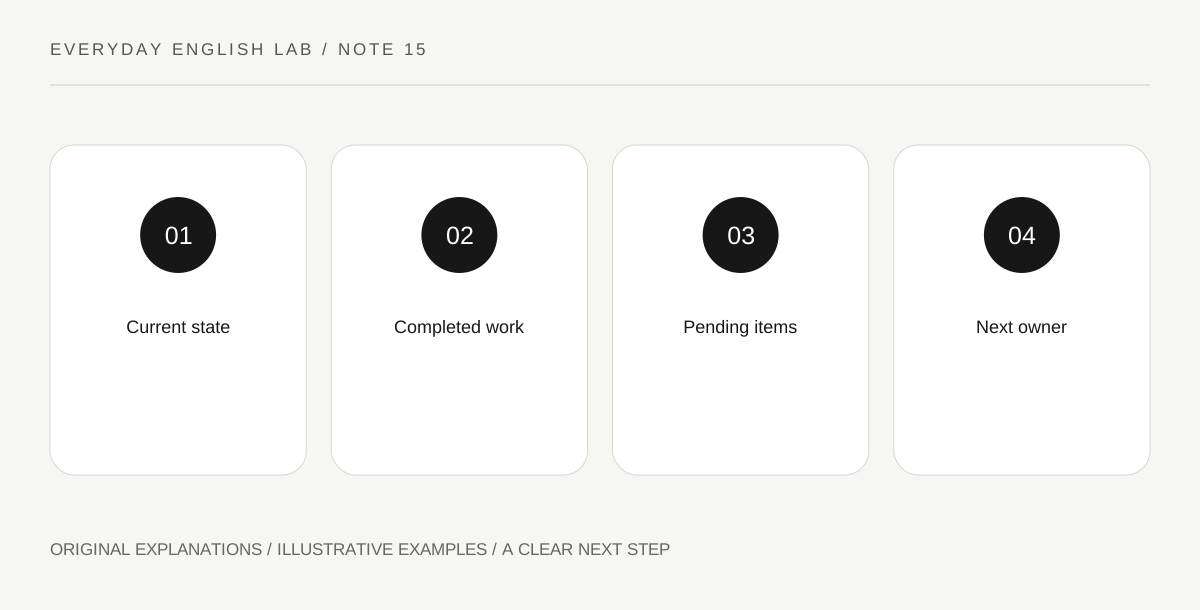
Original explanatory diagram. Read the full method and limitations below.
State the task and current state
The workshop registration list is updated gives the listener a starting point. Add the relevant file or location in the agreed work context. Avoid Everything is nearly done because nearly does not say which parts remain. In practice, use a fictional shared document rather than a real workplace file. The handover’s purpose is to reduce uncertainty for the next person, not to summarize how busy you have been.
Use finished actions for completed work
I checked the names and added the new registrations describes completed actions. Keep these separate from work that only began: I started checking the equipment requests is not the same as I checked them. The distinction prevents the next person from treating a partial review as complete. Your partner can mark each sentence as finished or unfinished, then explain which words led them to that interpretation.
Make pending items visible
Two requests are still waiting for a reply names an unresolved item. Add who needs to respond if the fictional task requires it: The venue has not confirmed the room yet. Avoid placing pending work inside a long paragraph about completed actions. A separate sentence or short line can make it easier to find. You can use still to show that an expected event has not happened by the time of the handover.
Give a specific next action
Please check the venue reply tomorrow morning tells the next person where to begin. If responsibility is not agreed, ask Could you take over the venue follow-up? rather than assuming ownership transfers automatically. End by inviting one clarifying question. In the exercise, the recipient should be able to state their first action and name the unresolved dependency without asking you to repeat the whole story.
Illustrative worked example
Illustrative handover: The workshop list is updated in our practice folder. I checked the names and added six fictional registrations. Two participants have not replied about equipment. The venue has not confirmed the room. Could you check for the venue reply tomorrow morning and update the room field? I will handle the two participant messages. The recipient replies, I will check the venue reply and update the room; you will contact the participants.
Questions that come up
Should I use past simple or present perfect?
Both can appear depending on the emphasis and context. Focus first on whether the sentence clearly presents the action as complete and relevant to the handover.
What if I cannot promise a deadline?
State the uncertainty directly. I do not have a confirmed reply time is more useful than inventing one that the next person may rely on.
References and scope
These sources support the factual background. Examples and exercises are original illustrative teaching material. References do not imply endorsement.
- British Council: Past simple — Past simple forms for completed events.
- British Council: Writing practice — Examples and practice for purposeful written communication.
- British Council: Present perfect — Present perfect form and its relation to the present.