Explain a choice with because and although
A choice can have a reason and a drawback at the same time. Practise explaining both without losing your main decision. This lesson uses ordinary plans and objects so you can concentrate on the relationship between ideas rather than on specialized vocabulary.
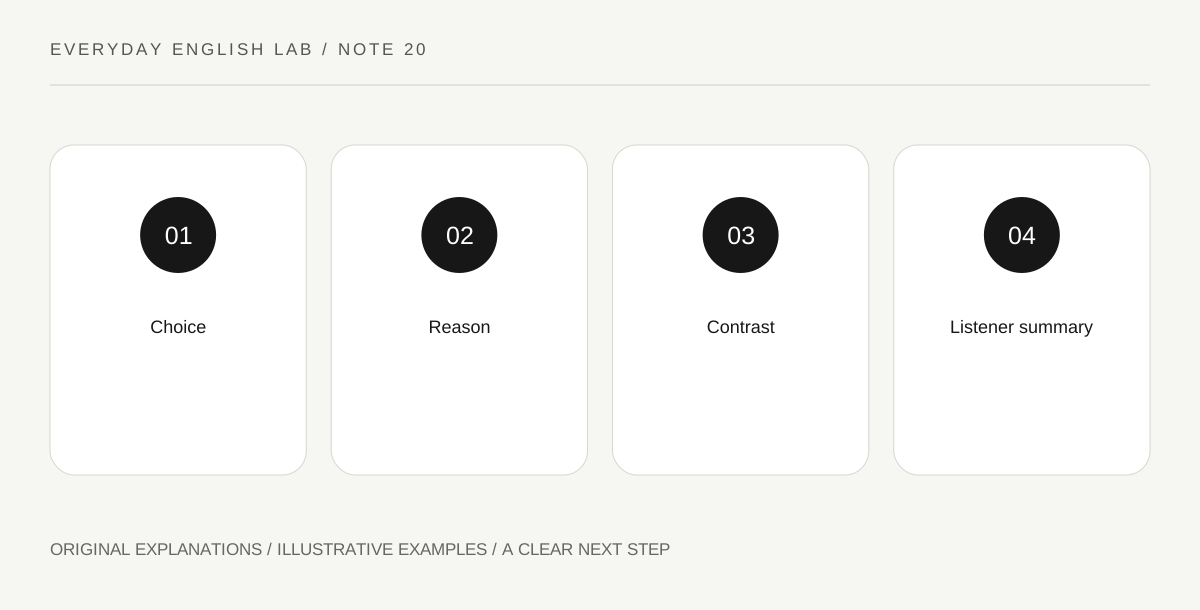
Original explanatory diagram. Read the full method and limitations below.
State the choice in a plain sentence
I chose the smaller desk gives the listener a conclusion. Before adding conjunctions, make sure the main decision is visible. A sentence can become difficult when several reasons appear before the listener knows what they explain. In practice, place two fictional options on cards and say which one you choose. Then ask your partner to repeat the choice without yet discussing whether they agree with it.
Use because for the deciding reason
I chose the smaller desk because it fits beside the window connects the decision to its reason. The reason should actually explain the choice. Because it is a desk adds a fact but does not distinguish it from the other desk. Compare two possible reasons and identify which one helps the listener understand the decision. This is a meaning check, not simply a request to insert a conjunction into any available gap.
Use although for a relevant contrast
Although it has less storage, I chose the smaller desk because it fits beside the window. The drawback does not prevent the final choice. Keep the contrast relevant: a storage disadvantage makes sense beside another desk, while an unrelated comment about lunch may not. For an easier version, split the ideas: It has less storage, but it fits beside the window. I chose that one. You can communicate the same reasoning with simpler sentences.
Check that the listener can follow the priority
Ask your partner to name your choice, main reason and drawback. If they identify the drawback as your reason, revise the wording or sentence order. Try a second scenario, such as choosing a train that leaves earlier but costs less in a fictional schedule. Do not add more conjunctions merely to sound advanced. A clear relationship between three ideas is more valuable than a long sentence that obscures which consideration mattered most.
Illustrative worked example
Illustrative explanation: I chose the smaller desk because it fits beside the window. Although the larger desk has more storage, it would block the cupboard door in our fictional room. The smaller desk gives me less drawer space, so I will keep supplies on an existing shelf. A partner summarizes: You chose the smaller desk for its fit, accepted less storage and planned to use a shelf. Now rewrite the explanation as three shorter sentences.
Questions that come up
Can I begin a sentence with because?
You can use a because clause before a main clause: Because it fits, I chose the smaller desk. Keep the complete meaning rather than leaving an accidental fragment.
Do I need because and although together?
No. Practise each relationship separately first. Combining them is useful only when the resulting sentence remains easy for your listener to understand.
References and scope
These sources support the factual background. Examples and exercises are original illustrative teaching material. References do not imply endorsement.
- British Council: Conjunctions — Because for reasons and although for contrasting clauses.